
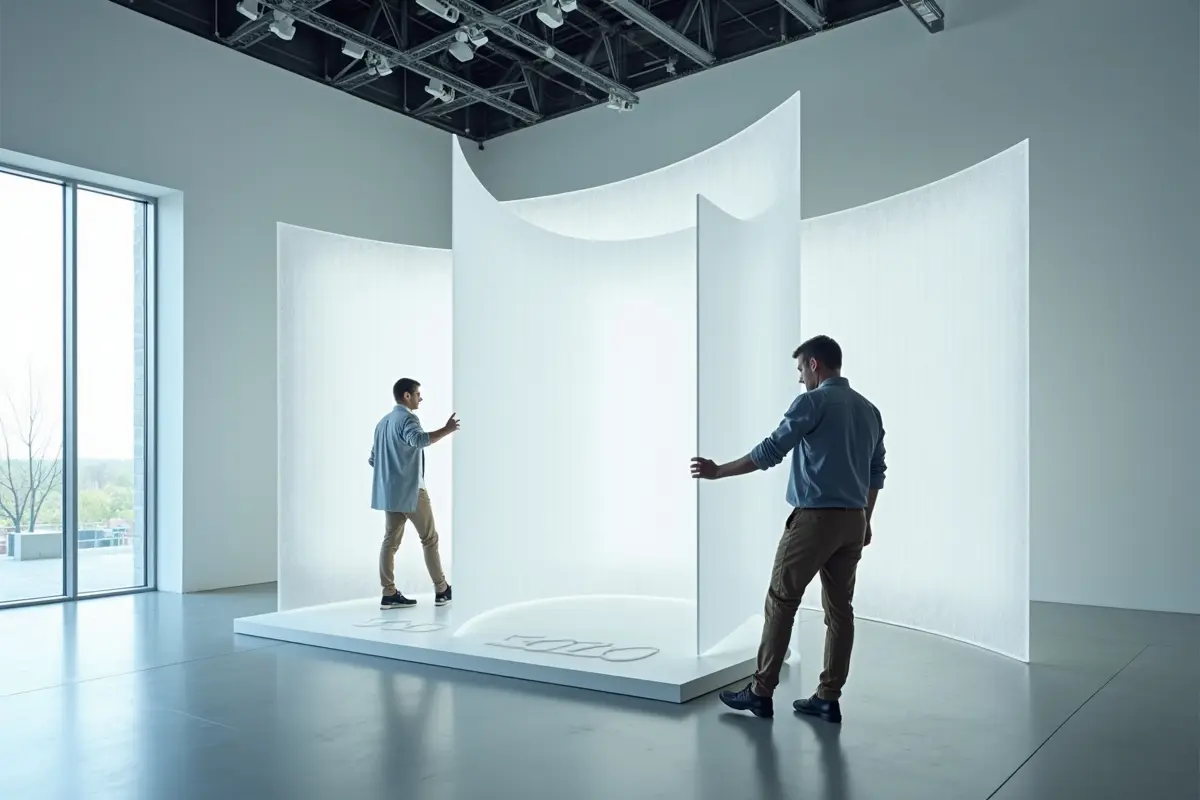
Why Lightweight Synthetics Are Replacing Heavy Materials in Modern Exhibition Design
There is a cost for every kilogram you add to a booth build. The more it weighs, the more you pay to ship it. Venue drayage fees, which are calculated solely based on weight, to move your goods from the loading dock to your booth are a growing expense to consider. For custom builds, clients with designers who still depend on heavy materials like timber and glass are at a disadvantage cost-wise before a single visitor shows up at the event.
Adopting lightweight synthetics instead of timber framing, MDF panels, and glass elements in the design process is not a compromise. It means you can build a bigger, bolder booth for less, and that’s what the best teams are already doing.
How Traditional Materials Became a Logistics Liability
MDF was the go-to material for custom exhibition stands for many years. It machines cleanly, paints well, and joiners know how to handle it. The downside is density. A typical MDF sheet weighs 40 kilograms or more. Multiply that by a full booth build, walls, counters, display plinths, overhead structures, and you’re essentially freighting a small house to every show.
Glass exacerbates this issue. It’s high in transit risk, expensive to pack safely, and its structural load necessitates additional framing that often tips over from design feature into visual (and spatial) obstruction. When venues impose weight limitations on suspended ceiling rigs, glass often must be automatically scrapped from your spec.
Acrylic (PMMA) is a transparent plastic material with a density of around 1.19 g/cm³. That’s less than half the weight of silica glass, which averages about 2.5 g/cm³, while providing up to 17 times the impact resistance (according to those old material science chestnuts). Suddenly, logistics aren’t looking quite so grim.
Light, Clarity, and the Visual Case For Synthetics
Painted MDF absorbs light. No matter how many LED strips you install behind an opaque timber panel, the result is an uneven glow, visible hot spots, and color inconsistency across the face. This familiar issue continues to frustrate retail and exhibition environments relying on backlit signage for maximum brand impact.
Translucent synthetics provide the solution. They diffuse LED backlighting evenly across their surface, delivering the kind of seamless, shimmering visual that discerning brands are happy to open the checkbook for. The optical quality is no accident. It’s why premium exhibition designers now count on acrylic panels as a fundamental element of a stand’s lighting design, rather than a building material.
For showcase cabinets, product display cases, and branded signage panels, achieving the visual clarity of glass is simply a matter of specifying precision-cut, high-grade perspex that arrives light enough to carry by hand and assembles on-site without specialist tools or extra build days.
CNC routing and laser cutting ensure it is fabricated to the correct tolerances, so that clean fit of modular components can be guaranteed at every new venue without shimming or adjustments to compensate for inaccuracies.
Overhead Rigging is Where Weight Limits Become a Design Constraint
Exhibition halls have strict load limits for anything hung from the ceiling. These aren’t recommendations or best practice, more the fixed and structural rules, and crossing the line means you’re paying to get that brand structure or suspended lightbox re-engineered so it can stand its ground on the floor.
Light, modern synthetics are why the idea of hanging an advertising structure weighing a tonne out over people’s heads is no longer entirely insane. Light, strong, and flexible plastics like polycarbonate and acrylic can do the work of industrial glass and timber at a tiny fraction of the weight. It turns out, a vivid, acrylic brand sign can weigh about the same as your old kitchen counter, while a polycarbonate sheet for high-impact architecture is about as heavy as a sheet of plate glass one-axis shorter and half the thickness.
Durability on the Road Matters More Than it Looks on a Spec Sheet
A stand that is pristine at the initial event but beaten up by the second or third is not meeting the durability requirement. Painted MDF is especially prone to chipping at the corners during transportation. And because neither paint nor timber are moisture-resistant materials, you’ll notice swelling and surface bubbling, too, when a semi-trailer is left overnight by a loading dock and exposed to the morning dew. After a couple of shows, your new timber stand could look about 10 years older.
Acrylic and polycarbonate do not absorb moisture at all. Those materials also do not chip at the edges like painted timber. In between shows, you can often polish out minor scratches. For a marketing team running six-month or year-long exhibition programs across several cities, therefore, the benefit isn’t marginal. It’s the difference between a stand that is always perfect and a stand for which your outfitting crew spend half a day fixing the damage every time.
Modular synthetic construction lends itself to this reuse over configurations as well. Used with a clever, modular framing system, the panels that gave shape to your full island installation at one trade show can quickly be reemployed to give shape to an inline installation at the next. So you immediately tap into at least a couple of those circular economy principles and do so without demanding that new materials must be obtained for each marketing push.
The Design Possibilities Follow the Physics
Once you don’t have to worry about weight limitations in your construction, you can start thinking big. We’re talking suspended structures that defy gravity, wall-to-wall light installations that reach the height of the room, see-through product displays, and intricate feature panels. These are the kinds of design elements you see in award-winning exhibition stands, and they’re not there by chance.