
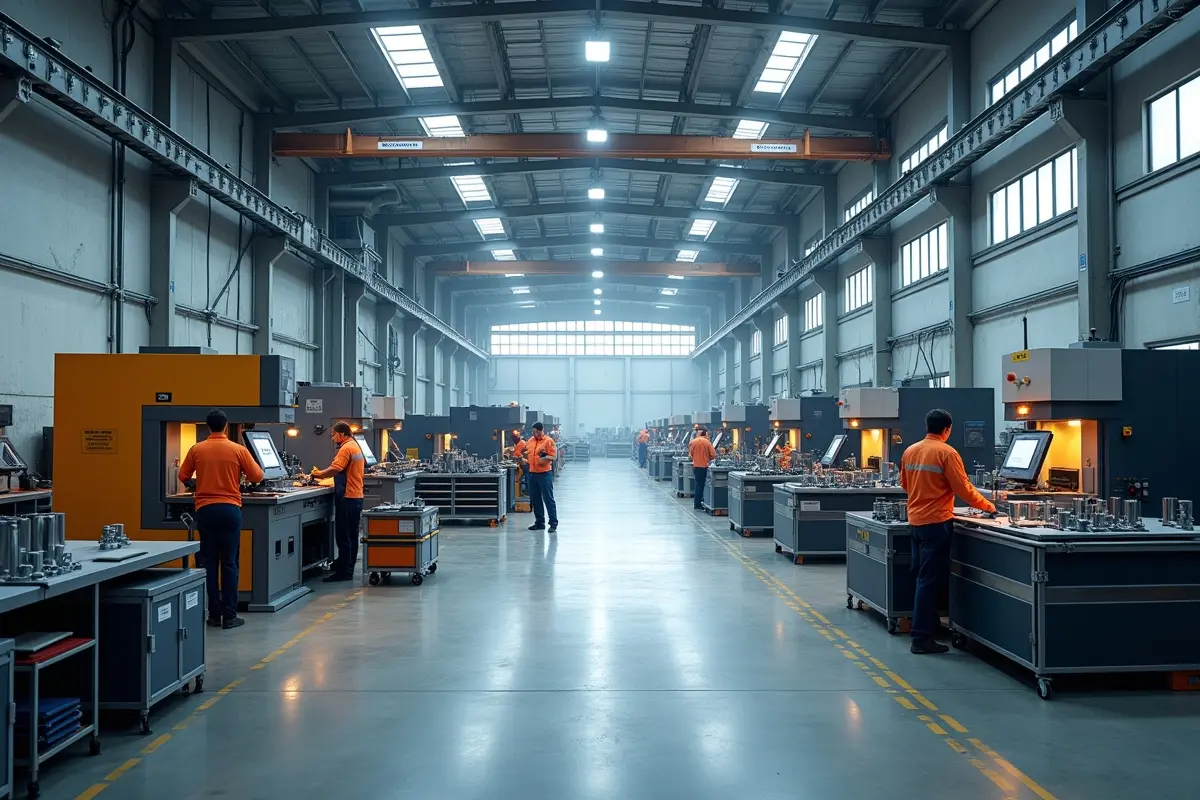
How to Optimise Your Workshop Layout for High-Volume Metalwork
The majority of high-volume metalwork issues are not welding issues. They are layout issues. The arc’s only on for a small portion of the whole amount of time it takes to make the production part, and every inch your torch has to move across that plate, every second the welder spends looking for consumables, every minute he spends waiting for a machine to spindle up to preheat or while waiting on a thermally constrained machine takes time off the production rate and contributes to wastage.
Value-added time accounts for less than 5% of total lead time in a traditional manufacturing context. Fix the floor before you try to fix the process.
Map the flow before you move anything
Let’s talk about how materials move. You should always think of them moving in a straight line. You don’t want operators carrying parts back and forth or passing stations they’ve already processed.
The best layout for your facility will depend on its shape and size. For example, if the same dock or door is used for delivery of raw materials and pick-up of finished product, a U-shape is a good option. If your facility is long and narrow, with delivery and shipping at opposite ends of the building, a straight-line flow is more likely to keep things running smoothly.
Walk the floor with a pen and paper. Draw the actual path a piece of steel takes from delivery to completion. If that line doubles back on itself or crosses another flow path, you’ve found a bottleneck before it causes one.
Separate your dirty and clean zones
All that grinding, heavy tacking, and high-amperage MIG work produce heat, spatter, and particulates. Finishing, inspection, and assembly don’t. But if these processes happen in the same metaphorical room, your floor shop will experience wear at the rate of your most demanding process.
Deliniate your space intentionally. Heavy welding and grinding belong on one side of the shop. Finishing and assembly belong on the other. Welding curtains and PPE screens aren’t just for keeping particulates out of the air the operator breathes; they’re physical stand-ins for the walls between your different environments.
Fume extraction needs to be part of the design for each dirty zone, not a retrofit. The ideal is centralized extraction ducting drops; portable units are a poor alternative not only because they create a floor-cluttering obstacle but also because they have to be repositioned each time workstations are rearranged.
Equipment selection is a layout decision
The machinery you select decides how your floor functions. For instance, a welder with a low duty cycle doesn’t just hold up one operator – they create a queue. If you’re welding long runs on thick structural steel or heavy plate, your power source’s duty cycle needs to carry output right through a full shift without thermal cutout becoming part of the schedule.
Workshops running 3-phase industrial plant often look to the wia weldmatic 350 once they’re operating in the high-volume environment. It’s made for sustained MIG welding at the amperages that structural fabrication genuinely demands. And it comes with an integrated wire feed that helps cut the set-up time every time you start a new run.
Gas supply factors into this as well. Plug your gas from individual cylinders and you’ll soon see arc time lost starting to really accumulate. Plug into a manifold system off a centralized gas supply and a bottle that lasts for a week suddenly isn’t an unusual event. Making this simple change to your workshop infrastructure pays back in arc-on time multiples across every shift.
Build workstations for repeatability, not just access
Storing consumables, wire spools, and hand tools at the point-of-use should be optimized so that operators can quickly and easily access what they need, right where they need it. This obviously helps keep everything organized, but it’s also about eliminating wasted motion. If an operator has to walk several feet to grab a grinding disc, and they do that 15 times a day, you’re losing production time. That’s not a line item on any daily report, but it’s real money leaking out the door.
With modular welding tables and standard hole patterns, it’s easy to adapt and reconfigure jig setups between production runs. But the real benefit is time saved. In most fabrication environments, it’s the time between runs that’s easiest to improve. Resetting jigs, re-squaring fixtures, re-establishing gas and power supplies – that’s all time and money sitting on the table.
Right alongside your layout’s workflow is ergonomics. The bench should be the right height, the torch easily accessible and easily positioned, and the workpiece should be presented to the operator at the right angle. A fatigued operator working at an uncomfortable bench will make more mistakes and slow down in the afternoon. That’s not a people problem, it’s a layout problem. A well-designed workstation should make this pretty easy to get right.
Power distribution and digital oversight
Machinery with high-amperage requires a dedicated, easily accessible 3-phase supply at each station. If cables are running all over your production floor, it’s a safety and a sanity issue. They won’t allow you to place your equipment judiciously, and they’ll serve as a physical roadblock for things like forklifts and roller tables.
Floor-mounted or overhead cable management for the power leaves it accessible but doesn’t restrict your design. Think about power distribution when you design the floor, not after you’ve ordered machines.
New welding power sources with digital monitoring allow floor managers to view arc-on time and wire usage in the moment. That information can be directly fed into resource planning – identifying which stations are underperforming, where consumable costs are running high, and where production targets are being met or missed before the shift ends.
A well-designed workshop floor reduces non-value-added time without asking anyone to work harder. That’s the real magic lever. Fix the floor and you’ll fix the productivity.